Video coming soon
How a bee sees a flower
Bees see ultraviolet light, and many flowers carry hidden patterns in that light that lead straight to the nectar.
The explanation
Like us, honeybees build their colors from three kinds of light receptors. Ours respond best to blue, green and yellow-green light. Theirs are shifted toward shorter wavelengths: their sensitivity peaks sit near 344 nanometers (ultraviolet), 436 nm (blue) and 544 nm (green). Bees gain a whole band of color that we can only measure with instruments, and they give up most of the red end of the spectrum.
That shift changes what a meadow looks like. A red flower tends to look dark to a bee, unless it also reflects ultraviolet, as the common poppy does. And many flowers that look like a single color to us carry nectar guides in ultraviolet: petal tips that reflect UV and a center that absorbs it, forming a target that points toward the reward.
Sunflowers show how rich this story can be. In wild populations, the size of the UV-absorbing center varies a lot. A 2022 study linked that variation to two pressures at once: pollinator visits, and climate, since larger UV patterns appeared in drier places, where they seem to help the flower lose less water.
When we photograph flowers in ultraviolet, we have to translate that light into colors we can see. Every UV image is, in a way, an interpretation: a false-color map of a world that bees experience directly.
Open questions
- Bees combine ultraviolet with other colors into hues we lack names for; researchers sometimes call one of them bee purple. How would you paint a color you can only infer?
- Honeybee combs are made of hexagons, and in 1999 Thomas Hales proved that a hexagonal grid divides a surface into equal cells with the least total wall length. Do bees build hexagons directly, or do round cells become hexagonal as warm wax settles? Researchers still debate it.
- What patterns surround us right now, written in a light we cannot see?
Process
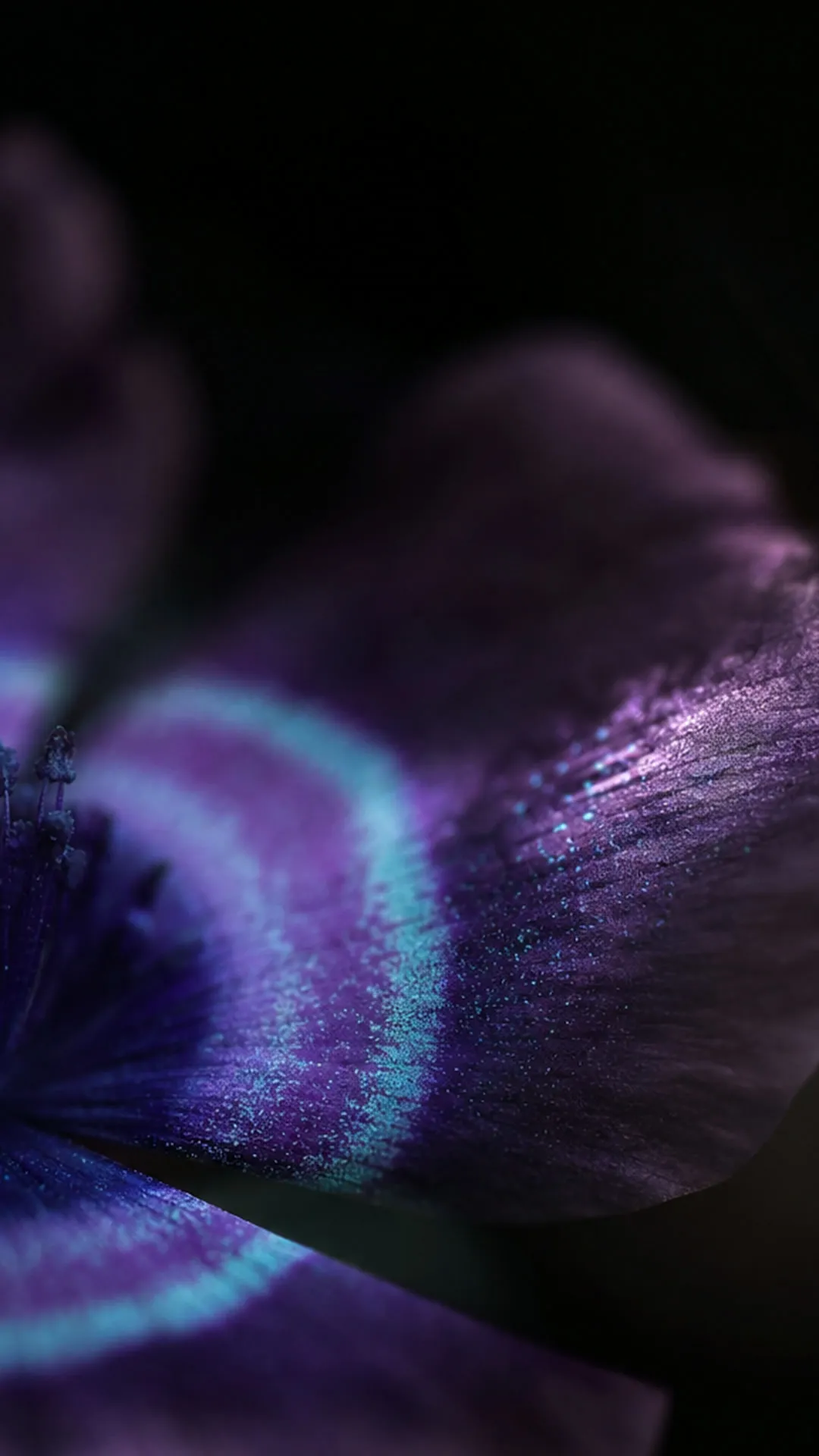
I began with UV photographs of flowers made by scientists and photographers, and I studied where the dark targets appeared. Then I chose a false-color palette of my own: violet for ultraviolet, turquoise for the reflective edges and a deep black for everything else. The illustration keeps most of the flower out of focus, so the eye travels to the center, just like a bee.
Sources
- Peitsch, D., Fietz, A., Hertel, H., de Souza, J., Ventura, D. F. & Menzel, R. (1992). The spectral input systems of hymenopteran insects and their receptor-based colour vision. Journal of Comparative Physiology A, 170, 23–40.
- Chittka, L. (2022). The Mind of a Bee. Princeton University Press.
- Todesco, M. et al. (2022). Genetic basis and dual adaptive role of floral pigmentation in sunflowers. eLife, 11, e72072.
- Hales, T. C. (2001). The honeycomb conjecture. Discrete & Computational Geometry, 25, 1–22.
- Karihaloo, B. L., Zhang, K. & Wang, J. (2013). Honeybee combs: how the circular cells transform into rounded hexagons. Journal of the Royal Society Interface, 10, 20130299.
Newsletter
Letters from the hive
One letter when a new reel is born: the science behind it, the sketches and the sources. Nothing else.
No spam. Unsubscribe whenever you like.
The list opens very soon. Thank you for your patience.