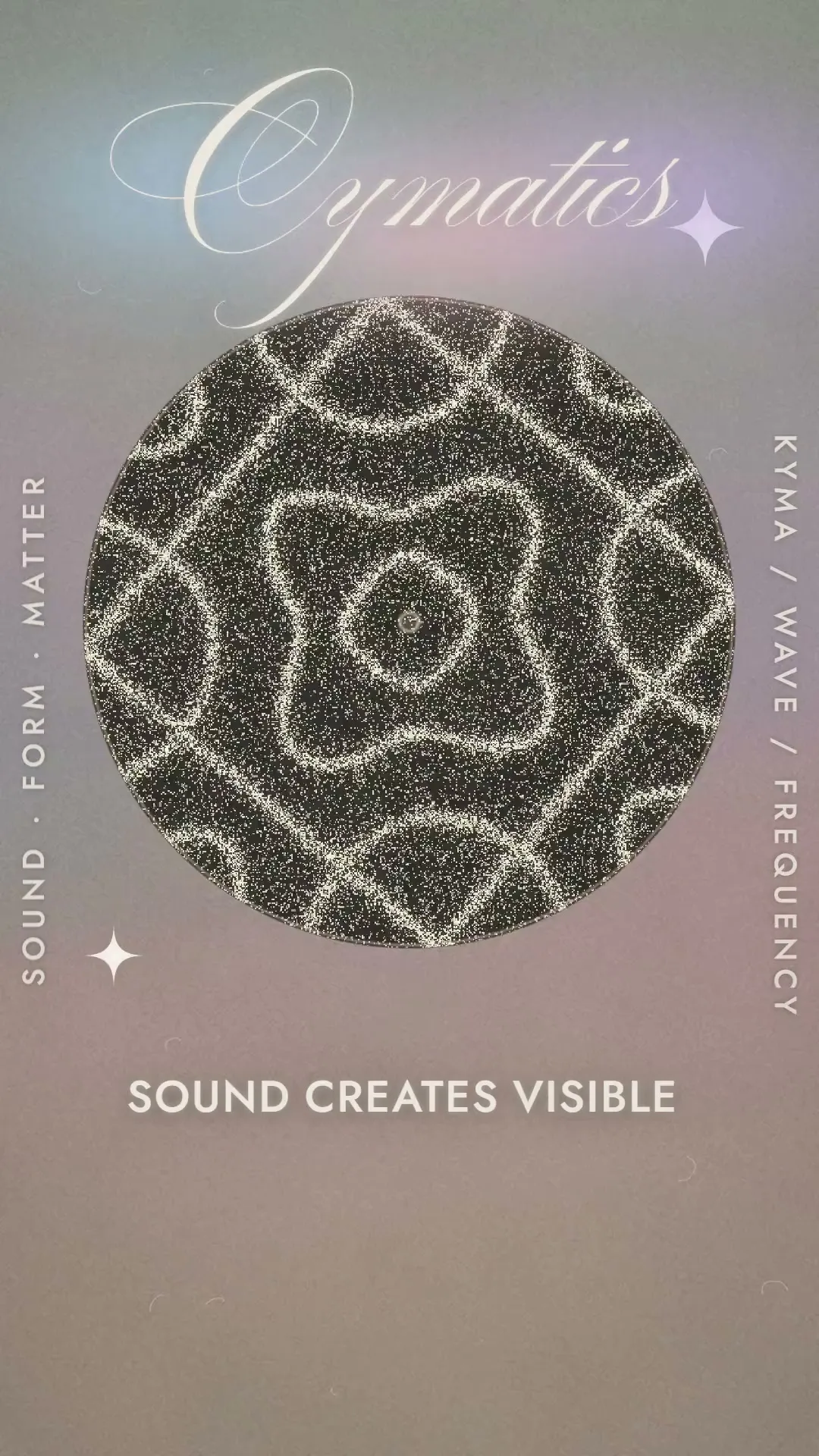
Video coming soon
Cymatics: sand that draws a sound
Why fine sand on a vibrating plate gathers into symmetric figures, and what those figures reveal about waves.
The explanation
When a thin metal plate vibrates at certain frequencies, it settles into a standing wave. Some regions swing up and down with great force; others, called nodal lines, stay almost perfectly still. Sprinkle fine sand on the plate and the grains bounce away from the restless regions until they come to rest where the plate barely moves. The figure that appears is a map of stillness, drawn by motion.
The German physicist and musician Ernst Chladni made these figures famous in 1787. He held brass plates by their center, scattered sand on them and drew a violin bow along the edge. Each sound produced a different design. Today we call them Chladni figures.
Every figure corresponds to one resonant mode of the plate: a way of vibrating the plate prefers. Which modes appear depends on the frequency, and also on the plate’s shape, thickness, material and on where it is held. Higher frequencies bring more nodal lines and more intricate designs, as if the sand were reading the score more closely.
The mathematics behind them took decades. Sophie Germain won the Paris Academy of Sciences prize in 1816 for her theory of vibrating elastic surfaces, and Gustav Kirchhoff refined the equations in 1850. Even today, predicting the figures for unusual shapes calls for computer simulations.
One delightful detail: in 1831 Michael Faraday noticed that very light powders behave differently. Carried by tiny air currents above the plate, they gather at the places that move the most. Same plate, same sound, opposite drawing.
The word cymatics comes from the Greek kyma, “wave”. The Swiss doctor Hans Jenny popularized it in the 1960s with photographs of sand, liquids and pastes shaped by vibration.
Open questions
- Many Chladni figures remind us of flowers, cells or mandalas. How much of that resemblance comes from shared symmetry, and how much from our eye searching for familiar shapes?
- What figures would a plate shaped like a leaf, a wing or a hexagon draw?
- If you heard a pattern before seeing it, would you recognize it?
Process
I started by watching slow-motion videos of sand on a plate and sketching only the lines where the grains settled. The palette came from the material itself: dark metal, champagne sand and a cold light, as if the plate were lit by the moon. For the reel I animated the transition between two modes, so you can watch the sand leave one stillness and find the next.
Sources
- Chladni, E. F. F. (1787). Entdeckungen über die Theorie des Klanges. Leipzig.
- Faraday, M. (1831). On a peculiar class of acoustical figures. Philosophical Transactions of the Royal Society of London, 121, 299–340.
- Waller, M. D. (1961). Chladni Figures: A Study in Symmetry. London: G. Bell.
- Jenny, H. (1967). Kymatik / Cymatics. Basel: Basilius Presse.
- Ernst Chladni — Wikipedia
Newsletter
Letters from the hive
One letter when a new reel is born: the science behind it, the sketches and the sources. Nothing else.
No spam. Unsubscribe whenever you like.
The list opens very soon. Thank you for your patience.