Video coming soon
Butterfly pea lemonade: the drink that changes color
A blue flower infusion that turns violet and pink when lemon touches it. The chemistry of anthocyanins in a glass.
The explanation
The petals of the butterfly pea (Clitoria ternatea) are rich in anthocyanins, the same family of pigments that colors blueberries, red cabbage and purple corn. In this flower they appear as a special group called ternatins, which give an unusually stable, intense blue.
Anthocyanins are molecular chameleons. Their structure changes with the acidity around them, and each structure absorbs light differently. In plain water the infusion is a deep blue. Add lemon juice, rich in citric acid, and the pH drops: the molecules rearrange and the color slides toward violet and then pink.
The exact shade depends on how concentrated the infusion is, how much acid you add and even the temperature. That’s why each glass becomes a small experiment: you can stop halfway and keep a perfect violet.
Open questions
- Red cabbage, black beans and hibiscus also change color with pH. Which other drinks in your kitchen could become indicators?
- Could you paint with this infusion and “develop” the image afterwards with lemon, like an invisible ink?
- Why do some plants make pigments that react so strongly to acidity? What role might that play in their own lives?
Process
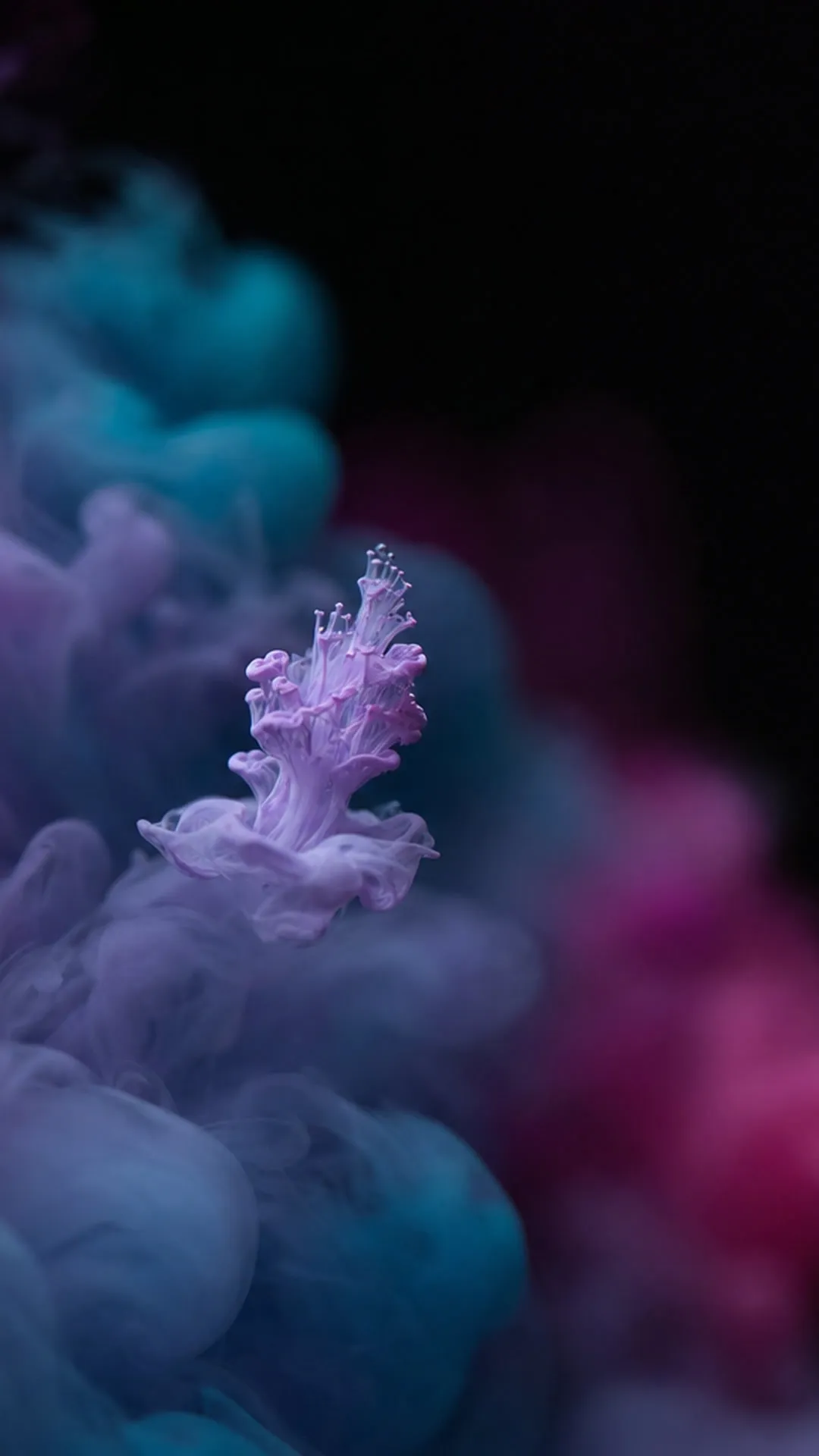
I filmed the moment the lemon falls into the glass at high speed, then studied the frames where blue and pink coexist. The illustration freezes that instant: two colors meeting in dark water, like ink clouds. I kept the background almost black so the color reads as light.
Recipe
Infuse the flowers, sweeten, and save the lemon for the table: the magic happens in front of your guests.
- 1 tablespoon dried butterfly pea flowers (about 15 flowers)
- 500 ml hot water, just off the boil
- Juice of 2 lemons (about 60 ml)
- 2 to 3 tablespoons honey or simple syrup, to taste
- Plenty of ice
- Steep the flowers in the hot water for 5 minutes, until the infusion turns deep blue.
- Strain, stir in the honey while it’s still warm and let it cool.
- Fill two glasses with ice and pour in the blue infusion.
- Serve the lemon juice in a small jug and pour it in at the table. Watch the blue turn violet, then pink.
Sources
- Oguis, G. K., Gilding, E. K., Jackson, M. A. & Craik, D. J. (2019). Butterfly pea (Clitoria ternatea), a cyclotide-bearing plant with applications in agriculture and medicine. Frontiers in Plant Science, 10, 645.
- Khoo, H. E., Azlan, A., Tang, S. T. & Lim, S. M. (2017). Anthocyanidins and anthocyanins: colored pigments as food, pharmaceutical ingredients, and the potential health benefits. Food & Nutrition Research, 61, 1361779.
- Clitoria ternatea — Wikipedia
Newsletter
Letters from the hive
One letter when a new reel is born: the science behind it, the sketches and the sources. Nothing else.
No spam. Unsubscribe whenever you like.
The list opens very soon. Thank you for your patience.